Kimaradt busz, kimaradt koncert
A belvárosi rendezvények felborítják a buszokat, az app néha hallgat, én pedig gyalog értem haza. Közben könyvesboltok, árkülönbségek és egy bohém bisztró is belefértek a történetbe.
Arles, 2025. 10. 03–04–05, péntek–szombati hétvége után, vasárnap este.
A Péri buszvégállomás a belvárostól délre van. A vasútállomás a belvárostól északra. Az én buszom a Péri megállóból indul, majd a vasútállomás érintése után északkeleti irányba folytatja az útját — legalábbis többnyire. Ha bármilyen rendezvény van a belvárosban, akkor lezárják azt, sőt a főutcák egy részét is.
A belváros egy félkör alakú terület; az egyenes oldalán pedig a Rhône-folyam.
(Itt minden, amin már elfér egy hajó, az már folyamnak számít; ezen két uszály is el tud menni egymással szemben, miközben két oldalt szállodahajók állnak.)
Maga a félkör, körútszerűen egymásba fonódó főutcák összessége.
A belvárosba, azaz az óvárosba nem tilos autóval behajtani, de változatos akadályokkal annyira körülményessé tették az autós közlekedést, hogy tényleg csak az hajt be, akinek nincs másik ötlete.
[Szintben eltérő burkolatok; az út közepén „felejtett” sziklák, amik ülőalkalmatosságok; látszólag rosszul tervezett oszlopok, amik között éppen nem lehet elférni; a teraszoknak úgy engedélyezték a területhasználatot, hogy az oldalsó tükör pont elsodor egy borospoharat — ezek miatt folyton kerülni kell a sofőröknek; plusz mindenhol turisták téblábolnak.]
Szóval, ha valami van a belvárosban, akkor a buszok nem vesződnek azzal, hogy a körút mindkét végét érintsék.
A városon belüli helyi tömegközlekedést úgy azzal segítok, hogy a déli falvakba tartó buszt északról, az északra tartó járatot délről indítják.
Gyalog húsz perc alatt végig lehet sétálni a belvároson, ha rendezvény van, akkor autóval ennél is több idő kell a körúton.
Az esetek többségében ezek előre jelzett történések, szóval nincs itt semmi gond: az autósok felkészültek, türelmesen araszolnak a körúton, a tömegközlekedést használók egyszerűen átsétálnak a másik megállóba, miután megkapták az értesítést a telefonon. Mint például szombat reggel — a piac miatt.
Ezt az egészet azért írom le, mert szombat este viszont nem jött értesítés.
Azt láttam, hogy futóverseny van a városban, de a főutcát csak időszakosan zárták le, így számomra nem volt egyértelmű, hogy a buszom kihagyja a Péri megállót (és csak a vasútállomásig jön be a városba, és onnan fordul vissza).
Sőt, éppen a tengertől (tehát délről) jöttem egy másik busszal, ami, miután kitett a Péri-nél, végighajtott a körúton.
Úgy terveztem, az utolsó busszal megyek haza, de az fél óra után sem érkezett meg.
Pedig én figyeltem a buszos applikációt!
A busztársaságnak csak néhány kattintásába került volna kommunikálni az utasokkal!
Ha legalább az indulás előtt szólnak valahogy, akkor sincs semmi baj, mert a rakparton öt perc alatt le tudok nyomni egy sprintet az állomásig!
Este fél hét volt a kitűzött indulás. Éjfélre értem haza — ebből három és fél óra volt a gyaloglás, a többi pihenés a padokon és a vacsora a büfében.
A bringámnak rossz a fékje, ezért nem merek nagyobb távot megkockáztatni, mint a szomszéd falu buszmegállója — odáig is csak óvatosan.
Én azt nem értem, miért nem módosítják a menetrendet, ha hetente többször ki kell hagyni megállókat?!
A már emlegetett Péri és vasútállomás nem az óváros körüli körúton van, hanem az attól eggyel kijjebb lévő párhuzamos utcákban.
Nem értem, mi az akadálya annak, hogy leüljenek beszélni a városvezetéssel annak érdekében, hogy a párhuzamos utcák lámpáit úgy szabályozzák, hogy az a buszokat segítse?
Így jobban érvényesülne az a hatás is, hogy a helyközi buszok besegítenek a helyi járatnak. Mert azokban az utcákban már vannak iskolák, irodák, lakások, helyiek is, nem csak turisták.

Amúgy lemaradtam egy koncert-show-ról.
Emiatt nem vittem még szervizbe a bringát, hogy éjjel haza tudjak jönni a szomszéd faluból.
Annyi történt, hogy benéztem a dátumot a szórólapon. Én azt hittem, vasárnap, a fesztivál záró napján van a koncert, de nem, szombaton volt. Ami amúgy logikus, hogy a leglátogatottabb nap végén van a buli.
Hát ezt benéztem.

Pénteken,
miközben megpróbáltam elintézni néhány dolgot a városban, meglátogattam néhány könyvesboltot is.
A nyári fotófesztiválnak szombaton volt az utolsó napja. Kourtney Roy: Turista című anyaga annyira tetszett, hogy meg akartam venni a belőle készült könyvet, de már mind elkapkodták; már csak a két évvel ezelőtti könyve volt a polcokon, azt akkor, a szakma díjazta, nem a közönség.
Keresés közben feljegyeztem néhány könyvet, amik éles kontrasztot alkothatnának a magyar politikával, de …
(itt azt sem tudják, hol van Magyarország, csak annyit tudnak, hogy az is egy orosz érdekkörbe tartozó terület)
… itt ezek csak egy-egy újabb tétel a könyvespolcokon.
- Gyermek részlegen:
- Lady Papa.
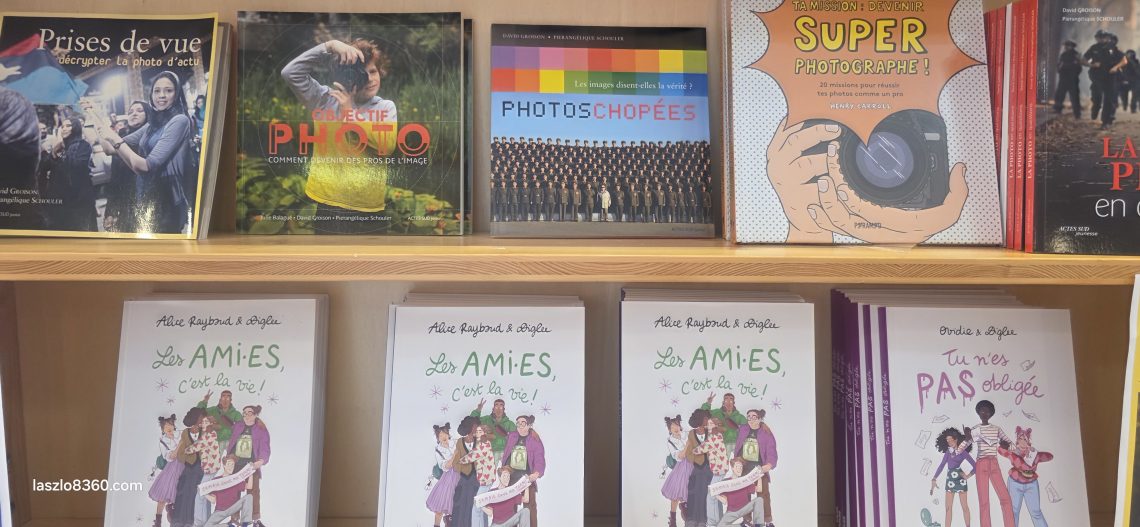
Ezt a címet talán nem is kell lefordítani, de a borító egyértelművé teszi: egy rózsaszín szőrmét viselő apuka és az ő tök átlag gyereke… - Egy borítón szerepel a néger, a duci, és a francia kislány.
A cím: Barátok, ilyen az élet.
Tizenévesek részlegén:
A borítón egy fejkendős, vidám szemű tinilány egy palesztin zászlóval. Ez a könyv a fotózásról szól.
A cím kb.: „Lövések eredete a fotók segítségével.” - Egy újabb tinikönyvön egy újabb csókolózó párt látni, teljesen normális.
Most épp egy edukációs könyvön.
- Lady Papa.
- Már az általános részlegen egy komplett polc foglalkozik az Izraellel kapcsolatos konfliktusokkal.
Mint például:- „A Hezbollah geopolitikája.”
- „A palesztin magyarázat a világ számára.”
- „Gáza gyarmatosítása.”
- És ami, nincs a világpolitika homlokterében:
« Barátunk, Kurdisztán. »
Amúgy olvastam már olyan újságot is, ahol Izraelt védték; habár a legtöbben ma már nyíltan kimondják, hogy népirtás folyik Gázában, ami semmilyen okból sem elfogadható.
A kedvencem az a cikk volt, amelyik Izrael álláspontját próbálta elmagyarázni, mindezt úgy, hogy egy mondat erejéig sem védte a vezetőit; csak magyarázott.

Pénteken jártam a Roquette negyedben is,
ami az óvárosnak egy része; ez afféle bohém negyed.
Egy bisztró nagyon megtetszett: nem voltak benne falak — úgy értem, hogy az asztalomtól elláttam a pult felett a picike konyhasarokig, és még a mosogatógépet sem rejtették el. A hely egyúttal egy antikvárium volt; az én asztalom sarkára is rá volt ragasztva egy árcímke.
Ami undorító volt, az a lehúzás!
Pedig a jelenség már jól ismert!
A turisták által látogatott helyeken két árlista van — és a világ összes városában ezt tapasztalom —: más árazás van, ha helybéli vagy, és más az árazás, ha kinézik belőled, hogy fizetőképes vagy.
Én nagyon szeretek elegáns ruhákat hordani, különösen büszke vagyok az ingeimre, ám a legtöbb esetben, amikor megyek valahová, épp az ilyenek miatt, az ócskább ruhákat veszem fel.
Azt hiszem, Isztambulban történt az az eset, amikor a repülőtérre menet (ahol az ellenőrzéseknél meg épp az segít, ha műveltnek látszom) kétszer annyit kértek el a kávéért, mint előző nap, amikor melegítőben és lógó pólóban érkeztem.
Itt, ma, ezen a jól dizájnolt helyen egy pohár sörért öt eurót kértek el.
Ez nem drága, hanem egyszerű pofátlanság!
Pedig a belsőépítészet, a koncepció nagyon lenyűgözött.
A Matisse-féle motívumos székek beszerzése akár egyedi stílusra is utalhatna.
Úgy tűnik, a műveltség (és az egyedi stílus) sem zárja ki a pofátlanságot!


Missed Bus, Missed Concert
After three days of closures, detours and slippery timetables, I only needed one last bus — and missed a concert with it.
Long story short: downtown events scramble the routes, the app sometimes stays silent, and I walked home.
Bookshops, price games and a bohemian bistro also made cameo appearances.
The Péri bus terminus lies south of the city center.
The train station is north of downtown.
My bus departs from the Péri stop, then, after touching the train station, continues northeast — at least most of the time.
If there’s any event downtown, they close it off, and parts of the main streets too.
Downtown is a semicircle; its straight edge is the Rhône River.
(Here anything that can carry a ship counts as a “river”; two barges can pass each other while hotel boats are moored on both sides.)
The semicircle itself is a bundle of interwoven ring-like main streets.
Driving into downtown — the old town — isn’t forbidden, but they’ve made it so cumbersome with assorted obstacles that only those enter who’ve run out of other ideas.
[Different-level pavements; rocks “forgotten” in the middle of the road that serve as seats; seemingly ill-placed posts you can’t squeeze between; terraces permitted so that your side mirror would clip a wine glass — drivers must constantly detour; plus tourists everywhere.]
So if something’s on downtown, buses don’t bother touching both ends of the ring.
To “improve” local transit, they launch the southbound village bus from the north and the northbound service from the south.
On foot you can cross downtown in twenty minutes; during events it takes longer than that by car on the ring.
Most of the time these things are announced in advance, so no big deal: drivers are prepared and patient, and public transport users simply walk to the other stop once they get the phone alert.
Like on Saturday morning — because of the market.
I’m writing all this because on Saturday evening there was no alert.
I saw there was a running race in town, but the main street was only closed intermittently, so it wasn’t clear to me that my bus would skip Péri (and only come into town as far as the station, then turn back).
In fact, I’d just come from the sea (so from the south) on another bus which, after dropping me at Péri, drove right along the ring.
I planned to take the last bus home, but half an hour later it still hadn’t arrived.
And I was watching the bus app!
It would have taken the operator just a few clicks to inform passengers!
Even a heads-up before departure would have been fine — I can sprint the quay to the station in five minutes!
The scheduled departure was 6:30 p.m.
I got home at midnight — three and a half hours of that was walking, the rest was bench breaks and dinner at the snack bar.
My bike’s brakes are bad, so I don’t dare attempt longer distances than the next village’s bus stop — and even that only carefully.
What I don’t get is why they don’t adjust the timetable if they have to skip stops several times a week?!
The already-mentioned Péri and the train station aren’t on the old town’s ring road but on the next parallel streets outward.
I don’t understand what prevents them from sitting down with the city leadership to time the lights on those parallel streets to favor buses.
That would also enhance the effect of intercity buses helping the local routes.
Those streets already have schools, offices, apartments — locals too, not just tourists.
By the way, I missed a concert show.
That’s why I haven’t taken the bike to the shop yet — so I could ride home at night from the neighboring village.
I simply misread the date on the flyer.
I thought the concert was on Sunday, the festival’s closing day, but no, it was Saturday.
Which is logical, really — the party is on the most visited day.
Well, I botched that.
On Friday, while trying to take care of a few errands, I also visited some bookstores.
The summer photo festival’s last day was Saturday.
Kourtney Roy’s “Tourist” struck me so much I wanted the book, but it had been snapped up; only her two-year-old book was on the shelves — lauded by the profession then, not the public.
While searching I noted a few titles that would make a sharp contrast with Hungarian politics, but (here they barely know where Hungary is, only that it’s in some Russian sphere of interest) here these are just one more spine on a shelf.
Children’s section:
Lady Papa.
No need to translate the title, the cover says it all: a dad in pink fur and his utterly average kid…
One cover shows a néger, a chubby girl and a French girl.
Title: Friends, That’s Life.
Teens’ section:
On the cover: a headscarf-wearing, bright-eyed teenage girl with a Palestinian flag.
The book is about photography.
The title roughly: “The Origin of Shots Through Photos.”
Another teen book shows yet another kissing couple — completely normal.
This time on an educational book.
Already in the general section there’s a whole shelf on conflicts related to Israel.
For example:
“The Geopolitics of Hezbollah.”
“A Palestinian Explanation for the World.”
“The Colonization of Gaza.”
I’ve read newspapers that defend Israel, too; though most now openly say genocide is under way, which is unacceptable for any reason.
My favorite piece tried to explain Israel’s position without defending its leaders for even a sentence — it just explained.
I also walked through the Roquette quarter on Friday, which is part of the old town — a kind of bohemian district.
I really liked one bistro: there were no walls — by which I mean from my table I could see over the counter to the tiny kitchen corner, and they didn’t even hide the dishwasher.
The place was also an antiquarian bookshop; even my table had a price tag stuck to the corner.
What was disgusting was the rip-off!
A well-known phenomenon, sadly!
In touristy spots there are two price lists — I see this in every city in the world — one for locals and another if they think you can pay.
I love wearing elegant clothes, I’m especially proud of my shirts, but most of the time when I go somewhere I put on my scruffier outfits.
I think it was in Istanbul on the way to the airport (where during checks it actually helps to look cultured) that they charged me twice as much for coffee as the day before, when I showed up in sweats and a droopy T-shirt.
Here, today, in this well-designed place they asked five euros for a glass of beer.
Not expensive — just plain cheeky!
The interior design and the concept impressed me, though.
Sourcing Matisse-like patterned chairs could even signal a unique style.
Seems culture (and unique style) doesn’t rule out cheekiness!
Arles, October 03–04–05, 2025 — after the Friday–Saturday weekend, Sunday night.
Bus manqué, concert manqué
Après trois jours de déviations, de fermetures et d’horaires glissants, il ne me manquait qu’un dernier bus — et avec lui, un concert.
En bref : les événements du centre chamboulent les lignes, l’appli se tait parfois, et je suis rentré à pied.
Entre-temps, des librairies, des écarts de prix et un bistrot bohème se sont invités dans l’histoire.
Le terminus de bus Péri se trouve au sud du centre-ville.
La gare est au nord du centre.
Mon bus part de l’arrêt Péri, puis, après un passage par la gare, continue vers le nord-est — du moins la plupart du temps.
S’il y a un événement en centre-ville, on le ferme, ainsi que des tronçons des artères principales.
Le centre forme un demi-cercle dont le bord droit est le Rhône.
(Ici, tout ce qui peut porter un bateau compte comme « fleuve » ; deux péniches peuvent se croiser pendant que des bateaux-hôtels sont amarrés des deux côtés.)
Le demi-cercle est un faisceau de grandes rues en anneau qui s’entrelacent.
Entrer en voiture dans le centre — la vieille ville — n’est pas interdit, mais on a rendu la circulation si pénible avec toutes sortes d’obstacles que seuls ceux qui n’ont plus d’idée s’y risquent.
[Revêtements à niveaux différents ; rochers « oubliés » au milieu de la chaussée servant d’assises ; poteaux placés de façon qu’on ne puisse pas passer ; terrasses autorisées si près qu’un rétroviseur balaierait un verre de vin — les conducteurs doivent sans cesse contourner ; et des touristes partout.]
Donc, s’il se passe quelque chose au centre, les bus ne s’embarrassent pas de toucher les deux bouts de l’anneau.
Pour « améliorer » les liaisons locales, on envoie la ligne vers les villages du sud depuis le nord, et celle vers le nord depuis le sud.
À pied, on traverse le centre en vingt minutes ; lors d’événements, en voiture sur l’anneau, c’est encore plus long.
La plupart du temps, tout cela est annoncé à l’avance, donc pas de souci : les chauffeurs sont préparés et patients, et les usagers passent simplement à l’autre arrêt après l’alerte reçue sur le téléphone.
Comme samedi matin — à cause du marché.
Si je raconte tout ça, c’est que samedi soir, aucune alerte n’est arrivée.
J’ai vu qu’il y avait une course à pied, mais la grande rue n’était fermée qu’épisodiquement ; il ne m’était donc pas évident que mon bus allait sauter l’arrêt Péri (et n’entrer en ville que jusqu’à la gare avant de faire demi-tour).
D’ailleurs, je venais de la mer (donc du sud) sur une autre ligne qui, après m’avoir déposé à Péri, a longé tout l’anneau.
Je comptais rentrer par le dernier bus, mais une demi-heure après, il n’était toujours pas là.
Pourtant, je surveillais l’appli bus !
Il aurait suffi de quelques clics à l’opérateur pour prévenir les passagers !
Même un message avant le départ m’aurait convenu — je peux sprinter le quai jusqu’à la gare en cinq minutes !
Le départ prévu était à 18 h 30.
Je suis rentré à minuit — dont trois heures et demie de marche, le reste en pauses sur des bancs et dîner au snack.
Les freins de mon vélo sont mauvais, donc je n’ose pas tenter plus loin que l’arrêt du village voisin — et encore, prudemment.
Ce que je ne comprends pas, c’est pourquoi on ne modifie pas les horaires si l’on doit sauter des arrêts plusieurs fois par semaine ?!
Péri et la gare ne sont pas sur l’anneau de la vieille ville, mais sur les rues parallèles, une ceinture plus au dehors.
Je ne vois pas ce qui empêche de s’asseoir avec la mairie pour régler les feux des rues parallèles de manière à aider les bus.
Cela renforcerait aussi l’effet des cars interurbains qui dépannent les lignes locales.
Parce que, dans ces rues, il y a déjà des écoles, des bureaux, des logements — des habitants, pas seulement des touristes.
Au passage, j’ai raté un concert-show.
C’est pour ça que je n’ai pas encore mis le vélo en révision — pour pouvoir rentrer de nuit depuis le village voisin.
J’ai simplement mal lu la date sur le tract.
Je croyais que le concert avait lieu dimanche, jour de clôture du festival, mais non, c’était samedi.
Ce qui est logique : la fête se fait le jour le plus fréquenté.
Je me suis planté.
Vendredi, tout en réglant deux-trois choses en ville, j’ai aussi visité des librairies.
Le dernier jour du festival photo d’été était samedi.
« Tourist » de Kourtney Roy m’a tellement plu que je voulais le livre, mais tout était parti ; il ne restait que celui d’il y a deux ans — primé par la profession à l’époque, pas par le public.
En fouillant, j’ai noté quelques titres qui feraient un contraste tranchant avec la politique hongroise, mais (ici on ne sait pas vraiment où est la Hongrie, seulement qu’elle serait dans une sphère d’influence russe) ici, ce ne sont que des dos de plus sur les étagères.
Rayon jeunesse :
Lady Papa.
Le titre se passe de traduction ; la couverture dit tout : un papa en fourrure rose et son gamin tout à fait ordinaire…
Sur une couverture figurent une « négresse », une ronde et une petite Française.
Titre : Amis, c’est la vie.
Rayon ados :
Sur la couverture : une fille voilée, yeux rieurs, avec un drapeau palestinien.
Le livre parle de photographie.
Le titre, en gros : « L’origine des “shots” par les photos ».
Un autre livre pour ados montre un autre couple qui s’embrasse — parfaitement normal.
Cette fois sur un livre éducatif.
Dès le rayon général, une étagère entière traite des conflits liés à Israël.
Par exemple :
« La géopolitique du Hezbollah ».
« Une explication palestinienne pour le monde ».
« La colonisation de Gaza ».
J’ai aussi lu des journaux qui défendaient Israël ; bien que la plupart disent désormais ouvertement qu’il s’agit d’un génocide, inacceptable pour quelque raison que ce soit.
Mon article préféré tentait d’expliquer la position d’Israël sans défendre ses dirigeants ne serait-ce qu’une phrase — il expliquait, simplement.
Je suis également passé par le quartier de la Roquette vendredi, partie de la vieille ville — un coin bohème.
Un bistrot m’a beaucoup plu : pas de cloisons — depuis ma table je voyais, au-dessus du comptoir, le minuscule coin cuisine, et même le lave-vaisselle n’était pas caché.
Le lieu faisait aussi office d’antiquaire ; une étiquette de prix était collée au coin de ma table.
Ce qui était dégoûtant, c’était l’arnaque !
Phénomène bien connu !
Dans les lieux touristiques, il y a deux cartes — je le constate dans toutes les villes du monde — : une pour les locaux, une autre si l’on vous croit solvable.
J’adore porter des vêtements élégants, je suis particulièrement fier de mes chemises, mais le plus souvent, quand je sors, j’enfile mes habits plus usés.
Je crois que c’était à Istanbul, en allant à l’aéroport (où, aux contrôles, paraître cultivé aide), qu’on m’a fait payer le café deux fois plus cher que la veille, quand j’étais venu en survêt et T-shirt avachi.
Ici, aujourd’hui, dans cet endroit bien designé, on m’a demandé cinq euros pour un verre de bière.
Ce n’est pas « cher », c’est juste culotté !
Pourtant, l’architecture intérieure et le concept m’ont bluffé.
Se procurer des chaises aux motifs façon Matisse pourrait même signaler un style singulier.
On dirait que la culture (et le style personnel) n’exclut pas le culot !
Arles, 03–04–05 octobre 2025 — après le week-end vendredi–samedi, dimanche soir.

Csokitortával kezdődni