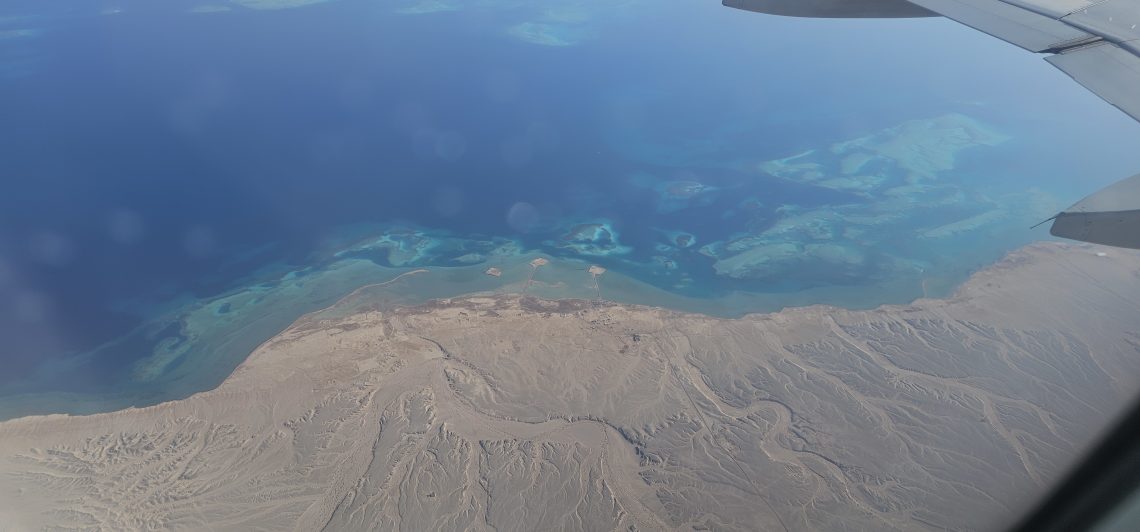
Departing Feelings
Where is Egypt? Somewhere between dusty alleyways and luxury resorts. A desert filled with dreams but no clear future. Love it, support it!

16:45
Flagging down a taxi takes two minutes—slow by Hurghada standards. In January, the beaches along Sheraton Road are practically deserted. Another two minutes of negotiation, and we settle on a 300-pound fare, while others at the airport were charged 500. This is precisely why I bargained in advance—realistically, 500 pounds is a fair price for a 20-minute ride.
16:50
A minor disappointment—the driver refused to make me a Turkish coffee. Oh well.
16:55
Before diving into the airport ordeal, I swap my t-shirt and still-damp swimwear for the disguise of an intelligent European traveler.
17:10
My flight, originally scheduled for 19:15, is delayed by half an hour. It’s a night flight, and those are always late. I planned for this, assuming we’d only reach Lyon by dawn—so, we’re still on track.
17:49
Exactly 30 minutes ago, I told one of the security officers that, honestly, I didn’t even want to leave.
Well… I’ve changed my mind.
The cashier just charged me 13 dollars for a tiny keychain. If they wanted to follow Egyptian business etiquette, they should have at least told me beforehand that it was actually 13.50 dollars before handing me the receipt.
17:51
Lesson learned: always ask the price first. Because, of course, no prices are ever displayed.
17:52
When I first walked into the duty-free shop, I wondered why a security guard was standing permanently next to the cashier.
Now I understand.
Even I had a fleeting thought of smashing the guy’s face into the counter when, after I handed him a 200-pound banknote, he casually informed me that he’d be charging my card in dollars instead. I could have bought the same keychain for 30 pounds on the beach, but I just wanted to get rid of my leftover change.
17:53
Honestly, the real fool is the one who doesn’t just throw the damn thing back at them. But clearly, they’ve been trained to recognize the precise moment when the customer has already emotionally committed to the purchase.
18:14
I’ve been pacing the terminal for 15 minutes now, trying to find a strategy to calm myself down.
18:15
I don’t even want to think about how many more times I’ll have to show my damn passport before boarding. Or how many times they’ll make me unpack my bag. Or how much more money they’ll find a way to charge me.
18:20
I once went through an airport in Europe where the only human interaction—across the entire journey from parking to security—was a single agent checking my ticket at the terminal entrance.
18:45
After consuming my aesthetically pleasing yet disappointingly dry rose-frosted muffin, my mood finally starts to settle. Acceptance sets in.
18:53
This is funny—every sign here is written first in Russian, with prices displayed in dollars. Only after that comes the English translation.
Egyptian pounds? Not accepted.
19:02
I’d say I’ll just eat and drink in France instead—if they’re going to charge French prices at the airport café (even more in the souvenir shop).
But I’m thirsty now.
For reference: three kilometers away in town, I paid exactly one-tenth of this price for a bottle of water.
19:31
So what does an airport departure process look like here?
- A police officer glances at my passport at the entrance.
- Immediately inside—after the restroom—there’s a full security screening: metal detectors, X-rays, shoes off, full pat-down.
- Another officer checks my passport and asks where I’m going. I must explain why I’m traveling to France when I’m not even French.
- Even if I’ve checked in online, everyone is given a freshly printed boarding pass, so everyone has to queue at the check-in desk.
- Here, I must explain that, yes, my EU passport allows me to enter France.
- They weigh the luggage.
- I receive a pink form to manually fill out my personal information (even though it’s already on my passport and boarding pass). Pens are not provided, and there’s exactly one desk.
- The border officer takes the pink form (does not read it), photocopies my passport (does not check it), and stamps my exit visa.
- Another officer checks that I have the exit stamp.
- Another full security screening: metal detectors, X-rays, shoes off, full pat-down.
- The next officer does not actually check anything—they just stamp my boarding pass to confirm I cleared security.
However, when it comes to boarding, efficiency kicks in:
- A staff member simply scans my barcode.
- If the scan fails for more than a second, the guard behind them pulls the passenger out of line.
- 230 passengers are loaded onto the plane in 230 seconds.
- The flight attendant reads the boarding pass and points directly to my seat—no need to search.
This process, both strange and slightly comedic to European eyes, does have a lesson: it’s far more efficient when everyone receives a standardized boarding pass. If passengers just wore them (forehead, lanyard, pocket), all staff could coordinate without delays.
19:53
The French easyJet flight attendants have the best-fitted uniforms.
19:55
Hooray, we’re flying! I love this. After Egypt, we’ll pass over Greece and Italy before reaching Lyon.
20:30
I let Spotify choose my music, and suddenly, I realize I’m a rock & roll fan.
Shoutout to Aunt Zsuzsa and Uncle Sanyi, my childhood neighbors—whenever we visited, they always had a Fenyő Miklós vinyl ready to play.
23:51
As soon as we land, I refresh my phone. The weather app switches from 27°C to -2°C.
Just looking at it hurts.
Do I really have to return to daily life?

Távozó érzések


