
Åsa Wikforss, Dobosi Beáta, Mårten Wikforss: That’s why it’s a democracy!
This book truly provides interesting thoughts and examples about democracy. It was fascinating to see how scientific analyses and personal stories can be combined on such a topic. As a result, the book made global political processes and their consequences much more understandable for me. Therefore, I believe that this book has truly contributed to my knowledge and understanding, and nuanced my stance on democracy.
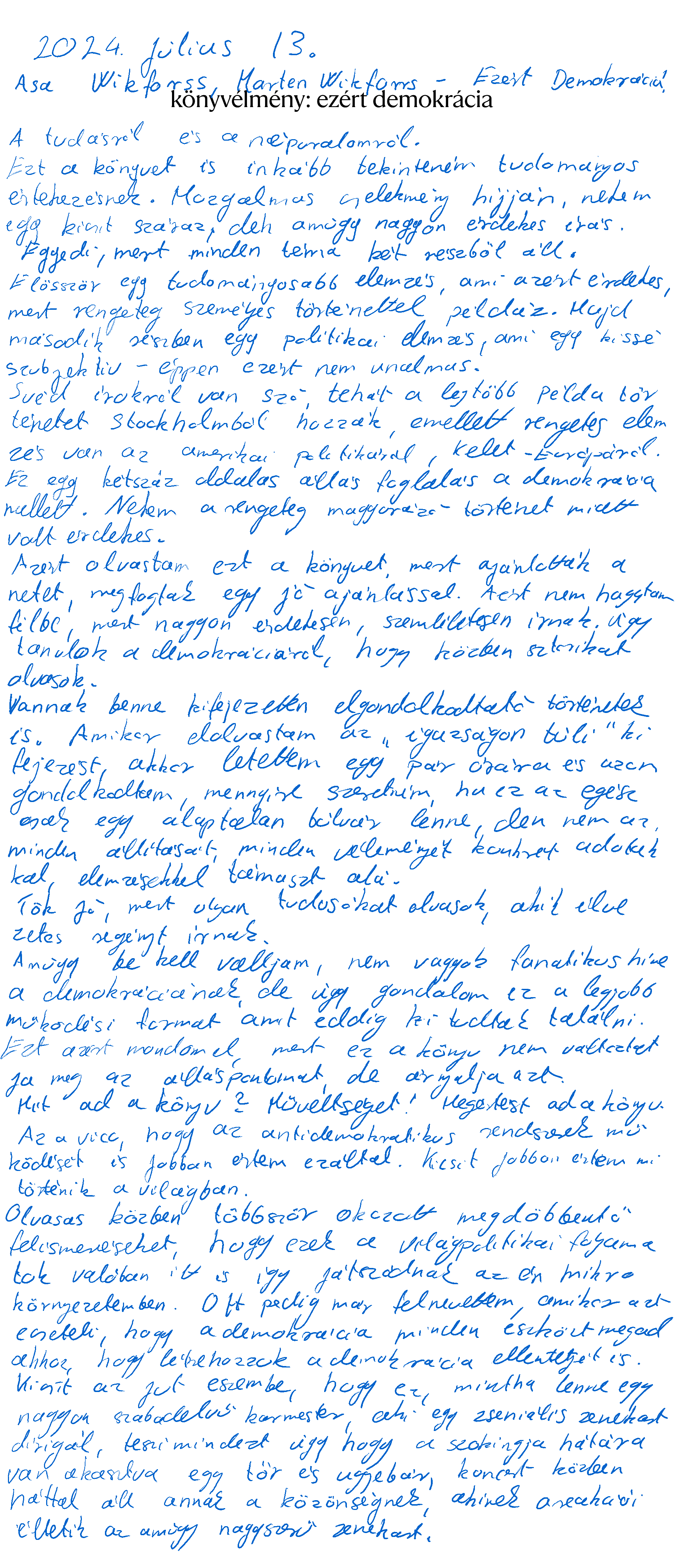
About knowledge and popular rule.
I would rather consider this book a scientific treatise. Due to the lack of a lively plot, it felt a bit dry to me, but otherwise, it’s a very interesting writing.
It’s unique because each topic consists of two parts. First, a more scientific analysis, which is interesting because it’s illustrated with numerous personal stories. Then, in the second part, there’s a political analysis, which is somewhat subjective – that’s why it’s not boring. It was written in Sweden, so most examples come from Stockholm, and there are also numerous analyses of American politics and Eastern Europe.
This is a 200-page statement in favor of democracy. It was interesting to me because of the numerous explanatory stories.
I read this book because it was recommended online, and I was intrigued by a good recommendation. I didn’t stop reading it because it’s written in a very interesting and vivid way. I learn about democracy while reading stories.
There are also some thought-provoking stories in it. When I read the expression “beyond truth,” I put the book down for a few hours and pondered how much I would like it if this were just groundless tabloid gossip, but it’s not, because it supports every claim and opinion with concrete data and analyses. It’s great because I’m reading scientists who write enjoyable novels.
By the way, I have to admit that I am not (to a radical extent) a fanatic supporter of democracy, but I think it’s the best form of governance that has been invented so far. I say this because this book doesn’t change my stance, but it nuances it.
What does the book provide? Knowledge! Understanding from the book. The joke is that I also understand the functioning of antidemocratic systems better as a result. I understand a little better what’s happening in the world.
While reading, it often caused startling realizations that these global political processes really unfold here and now in my microenvironment. And I’ve already grown up there, when it’s being emphasized that democracy provides every means to create its opposite.
It occurs to me a bit like there’s a very liberal conductor who directs a brilliant orchestra, all while a dagger is hanging on the back of his tuxedo, and of course, during the concert, he stands with his back to the audience, whose reactions enliven the otherwise great orchestra.
July 13, 2024.
“When the Oxford English Dictionary chose the expression ‘beyond truth’ as the word of the year in 2016, it was rightly noted that the ‘beyond’ should not be taken in the usual sense. It rather indicates that truth no longer matters, it has become irrelevant. According to this definition, it sounds like this: a situation in which objective facts are less important to public opinion than emotions and opinions.”
“Simplified: people believe what they want, not what they have good reason to believe.”
“Democracy is based on the unspoken and mutual agreement that compromise is most advantageous for all parties in the long run.”
“If Haidt is right that reasoning is completely ineffective in matters of value, then a rather bleak picture emerges of the possibility of a meaningful debate in democracy, as political issues also involve matters of value. There is nothing left but to stick to our feelings and try to outshout everyone. But we have reason to believe that Haidt is wrong, and reason can influence our moral judgments. We also have reason to believe that open debate plays an important role in moral development.”
“…not because he presented logical arguments. It is undeniable that King’s speech is a rhetorical masterpiece, and it is an empirical question what affected people in it.”
“Because democracy is based on the idea that every citizen is rational and has the right to understand the basis of political decisions.”
“One of the great weaknesses of the system is that those who want to undermine these freedoms can abuse them, and the disputed question of political science is what can and should be done about it. Joseph Goebbels, Hitler’s propaganda minister, allegedly said, ‘One of the best jokes of democracy is that it has given all the necessary tools to its mortal enemies for their destruction.’ However, in digital democracy, it is much more difficult to mitigate the damage that the enemies of democracy can cause by abusing civil liberties.”
“Those who are deceived are not free; those who deceive make them objects.”