Giza
In Giza, I experienced the monumental wonders of history up close: the colossal granite stones of the pyramids and the imposing presence of the Sphinx. The sheer scale is incomprehensible, and the experience both inspired and made me reflect on the contrast between the ancient and modern worlds. Though the day followed a strict itinerary, these moments will stay with me forever.

1:02 PM
After the morning at the Egyptian Museum in Cairo, I’m now in Giza. I’ve already had coffee and been introduced to a perfume demonstration.
Photo
1:06 PM
Just a few hundred meters away from the perfume stop in a straight line, but a 20-minute bus ride later, we arrive at a garden restaurant. Here, we’re served a buffet lunch with an appealing selection.
Of course, there are the obligatory pizza and spaghetti bolognese, but there are also fresh salads, dressings, sauces, chicken, and a cylindrical meat dish that I find particularly appetizing. They say it’s beef, and it seems to have been cooked over an open flame.
Freshly grilled dishes are generally the safest choice when traveling in unfamiliar places, and this meal immediately triggers my Pavlovian reflex. I add rice and balsamic vinegar salad to my plate.
After a bleak breakfast of muesli and protein bars, I’m thoroughly enjoying this lunch.
I notice a staff member bringing more of the cylindrical meat from the grill, so I go for a second serving. From what I can see, they shape the minced meat around a metal rod, which is then placed directly over the fire. It’s a clever method because the meat cooks through evenly thanks to the metal rod.
Photo
1:45 PM
We’re only two streets away from the archaeological park as the crow flies, but the bus has to take a longer route to get there.
Even on the map, you can see that “park” is not the right word for it; it’s the size of a small city like Keszthely.
The surrounding area is so overburdened by urban sprawl that highways encircle the site.
Photo 1
Photo 2
1:55 PM
I spot a mobile signal tower disguised as a palm tree – clever design.
In the background, the silhouettes of Giza’s three pyramids come into view.
Photo
2:23 PM
The stones of the first pyramid are as tall as a standing person. I can see this from the bus window.
Photo
2:25 PM
The second pyramid still has some of its original outer casing intact at the top. So this massive “pile of stones” was once covered with finely polished slabs.
Why would they do this?
Because thousands of years ago, one man believed he could achieve immortality if his embalmed body was placed beneath such a monumental tomb.
And what did he actually achieve?
He became a tourist attraction in a museum.
Not just for himself, but for his entire people, he created immortality.
(Note: My musings aren’t based on scientific evidence.)
Photo
2:35 PM
The bus takes us directly to the third pyramid.
Movies don’t show that Giza is built on a hill. We’re about a 20-minute drive from the Nile. Did they really haul these massive stones all the way up here from the river?
Photo
2:36 PM
Between the three pyramids, people are transported in horse-drawn carriages, on camelback for those wanting a more stylish experience, or on foot for the budget-conscious.
Because of the scale, the pyramids seem closer to one another than they actually are. I’d estimate there’s at least a kilometer of distance between each one.
We park near the top, where the same caravan of buses that we’ve been traveling with all day is gathered.
Photo
2:37 PM
We’re greeted by countless vendors. Our guide leads us to one specific vendor – now I understand why he advised us not to buy souvenirs at the museum earlier. He likely gets a commission here, which I don’t mind.
But what he didn’t mention (something I know from frequenting museums) is that museum gift shops usually offer higher-quality souvenirs than roadside bazaars – or, in this case, stalls in the sand.
Even at the museum, I didn’t feel the urge to shop.
Photo
2:38 PM
I pay €15 to visit a burial chamber, while most others spend the same amount to enter a part of the desert where they can capture a photo of all three pyramids in one shot.
Photo
2:39 PM
We head to the uppermost pyramid. It might sound ordinary when said out loud, but it’s an incredible experience to touch these granite walls.
It’s hard to imagine how they were made, how much sweat it took, and how they were transported here.
I can’t convey the scale – if each stone is about one and a half meters tall, how high is the top? I can’t even see that far, though the guide and I are joking about how I keep switching between my glasses and sunglasses.
Photo
2:40 PM
We first climb up a wooden staircase to the side of the pyramid, then descend. It starts off fine, but at one point, the passage is only about waist-height, barely wide enough for two people to squeeze through sideways, and it’s warm inside.
Using common sense, I find it hard to believe they could have carried anything or anyone down here.
It takes about five minutes to descend. The walls are plain, without decorations or patterns – maybe the burial chamber itself is different.
Everyone feels let down because the chamber is just an empty room. Its floor is half sand, half stone, and its ceiling is shaped like a half-cylinder.
The room’s height is about five meters at most, and its length isn’t much more.
It’s hot and humid inside.
Photo
“Would you like me to take a photo of you with your phone?” the guard kindly offers.
“No need,” I reply. “I was only here to trace the marks of history.”
Photo
2:53 PM
When I resurface, I have 30 minutes of free time left.
Despite the underwhelming experience in the chamber, I’m not upset – in fact, I’m glad I went down!
The problem wasn’t with the chamber itself but with the communication. If the information provided were more thorough, fewer people would likely opt for the experience, reducing revenue.
Photo
2:55 PM
I walk to the second pyramid, which looks close, but the rocky sand and immense scale make the trek tiring. Still, my goal is achieved: I touch another piece of history.
I skip the first pyramid because I don’t want to rush – I already admired it thoroughly from the slowly moving bus earlier.
Photo
2:56 PM
Thank you, sunlight, for shining directly behind the pyramid’s peak at the perfect moment for this photo, giving it a halo effect.
Photo
2:57 PM
It’s crazy – no photo can capture the sheer size of these structures!
And, of course, the cityscape only fits partially into the frame.
How big is this city? How massive is the project to build the new capital?
The government has decided to address Cairo’s unlivable conditions by constructing a new capital city. Good luck with that!
Photo
3:01 PM
Inspired by the kids playing nearby, I decide to climb up the pyramid wall myself.
It’s a great experience, and I’m as thrilled by every grain of sand as a child on a playground.
It’s good to be here.
Photo
3:05 PM
One of the security guards whispers a tip about the best spot to see the pyramids’ angles. He also offers to take my photo with my phone.
No, I’m not handing over my device, nor am I tipping anyone for a photo I don’t need.
Photo
3:10 PM
This half-hour break only allows me to switch into “Japanese tourist mode” and snap photos of everything.
I knew from the start of the day that Cairo is worth revisiting for several days, and that’s best done independently.
I like to take my time, walk through everything, and read all the details in museums.
Today’s itinerary, however, is just about rushing us through the main points, like a herd of dairy cows.
Photo
3:12 PM
It’s still surreal that I’m here, experiencing in person what I’ve only read about in history books.
Photo
3:13 PM
The camels are quite charming. One day, I’d like to ride one, but today I neither have the time nor the inclination to pay for it.
Photo
3:45 PM
I notice there are other pyramids I’ll have to visit another time. But now, we’re back on the bus, inching toward the Sphinx.
3:50 PM
We’re given just ten minutes – not enough to walk around the Sphinx, only enough to pass by and take some photos.
This is how it goes.
Today wasn’t meant to be culturally deep; it’s more of a “Japanese-style” experience. I’ll enjoy seeing everything from the roadside.
Photo
3:55 PM
This single statue is bigger than my father’s house.
It’s embedded in the hillside, with its base now below the ground level. No wonder it was buried for centuries.
The area around it has been excavated, but it would still take ten minutes of continuous walking just to circle it.
The setting sun makes it hard to take proper photos, but I’ll just enjoy it with my own eyes.
Photo
3:56 PM
I wonder if it’s solid on the inside. I can see that it’s constructed from stones as large as those of the pyramids.
There are still restricted areas and ongoing excavations here. This massive archaeological site was once the size of a city – a city of the dead.
I try to count the rows of stones but get stuck on how to convey the immense scale.
Photo
3:57 PM
I’d say history comes to life, but this “cat” is made of stone and hasn’t moved in millennia – except in the movies.
Photo
4:03 PM
I’m amazed that I haven’t seen a single accident yet, even though I can’t spot any traffic signs or systems here.
The intersections beneath the archaeological site feel more like a kindergarten playground, where everyone moves in whatever direction they please at their own speed.
Right now, we’re heading toward a papyrus institute. Just like in a playground, we’re riding the biggest “toy,” and everyone else has to make way for us.
Photo
4:10 PM
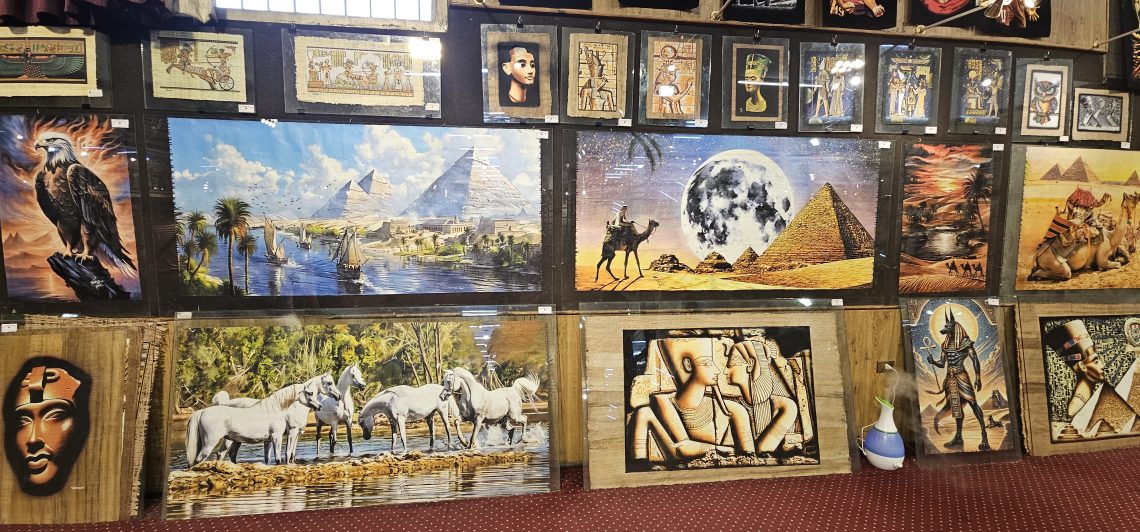
Ah, so it’s called an “institute” because the papyrus merchant decided to name it that.
We’ve entered yet another commercial stop.
To be fair, this one is better than most since it includes a 10-minute demonstration before revealing that the price for a papyrus poster is €25.
Photo
4:20 PM
I didn’t catch the name of the plant used to make papyrus, but it looks like young, green reeds.
The long, straight leaves are rolled into tubular shapes and then struck with a rubber mallet to break the fibers.
The plant is cut lengthwise, and we tested it – the long, straight strands are nearly impossible to tear apart. Now I understand how these documents have lasted for thousands of years.
The strands are soaked in water (or a liquid that looks like water) for several weeks.
According to the demonstrator, this softens the remaining stiffness and flattens their tubular shape.
Afterward, they’re arranged in a cross-weave pattern, similar to the way my grandfather used to demonstrate rug weaving.
The finished sheet is placed under a press for a week, resulting in a super-strong, nearly translucent piece of paper.
Photo
4:55 PM
From the bus, the chaotic traffic seems almost comical.
I see a small car that’s been hammered back into shape so many times it’s lost its original form.
Another vehicle’s frame is half-eaten by rust.
In the parking lot, I spot a brand-new Audi parked next to a rickshaw with its canvas roof torn to shreds.
In the intersection, perpendicular traffic crawls along two-by-two lanes, while at a 45-degree angle, a herd of camels casually crosses.
Horse-drawn or donkey-drawn carts weave between cars – as do pedestrians.
Photo
5:03 PM
We bid farewell to Giza with a sunset over the usual traffic chaos.
Photo
5:25 PM
As far as I know, the archaeological site is already in the outskirts of Cairo. But from there, it still takes us another 20 minutes of driving before the residential buildings along the road start to disappear.
There are rows of apartment blocks stretching for hundreds of meters, some as tall as 25 stories.
Photo
7:43 PM
It seems like Egyptians have a real love for domes.
This restaurant, for instance, has a dozen small domes covering its roof. I see this design element often.
We’ve stopped at the same gas station as earlier, with the same eleven buses, minibuses, and two police cars parked here.
Photo
7:44 PM
I think the driver of our bus has been driving nonstop for the entire 600-kilometer round trip – roughly six hours each way.
The license plate suggests this is a decommissioned bus from Germany, yet it’s barely 10 years old and still quite comfortable.
Photo
7:46 PM
I’m growing more fond of Egyptian music. Many people here listen to tunes that feel meditative and calming.
Photo
7:48 PM
Oh, and the people I assumed were German travelers? It turns out they speak Russian as their first language but choose not to use it.
I’m not sure of their nationality – maybe they’re Ukrainian and moved to Hamburg.
It felt nice to exchange a few words with the girl. I was genuinely curious about who they were and how they ended up in Hamburg.
Photo
7:58 PM
Now this is something: I just noticed that some buses are accompanied by armed security guards.
Photo
7:59 PM
It’s almost below my notice at this point, but every public building, even simple shops or offices, is equipped with metal detectors, and everyone has to pass through them one by one.
And I do mean everywhere.
Photo
8:04 PM
I just realized that our bus driver also carries a gun.
Photo
8:15 PM
At the end of the day, everything balances out.
I’ve seen so many things that left me in awe.
I keep thinking that everyone should see this side of our world too.
There are moments that are as breathtaking as any curated postcard, yet I wasn’t expecting them.
Though there’s nothing surprising about these sights, the experience still hits hard, leaving me speechless and overwhelmed. I search for words but find only wonder.
These memories will stay with me forever.
Photo
8:44 PM
What’s this smell – gas or petrol? Should I start praying?
We’re driving along the coast, but it’s still part of the desert – the sand reaches all the way to the sea.
This must explain the poor road quality, as sand blows across it constantly.
I can only tell this from the map because it’s pitch dark outside.
Photo
8:52 PM
There are oil fields around us. I just spotted a point on the map that confirms this – it explains the smells.
Photo
8:54 PM
I can see lights on the other side of the Gulf of Suez.
9:10 PM
Here, people don’t ask where you live or who you are; instead, it’s, “Which hotel and room number?”
Photo
9:30 PM
So, everyone on this bus speaks Russian – even the coffee vendors and shopkeepers at every stop.
I wouldn’t be surprised if all of today’s stops and shops belong to the same “corporate group.”
There are eight people, however, who refuse to speak Russian, plus me, somehow mixed into their group by the organizers.
I guess they thought Hungarian was just another Slavic language, like those of our neighboring countries.
Photo
Giza, Thursday, January 9, 2025

Gíza