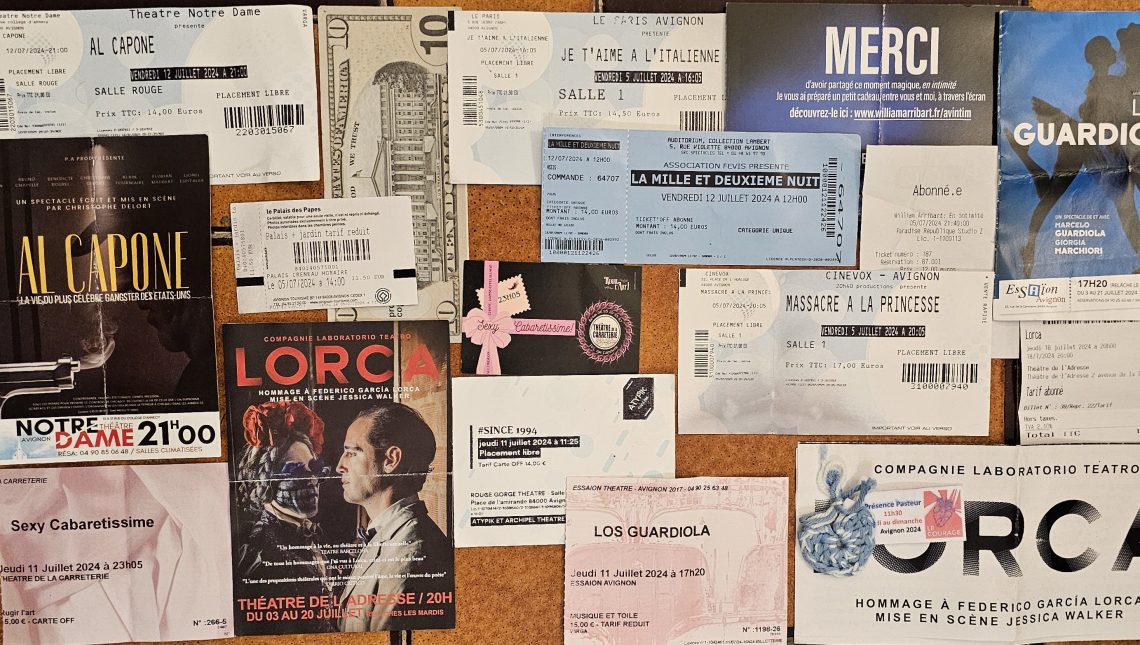
There are still a few thoughts left after the theater festival, where I only spent three weekends because there were no more. While the program series was ongoing, I was there on all my days off.
These are one-act plays, shows lasting a maximum of fifty to ninety minutes; Minimal budget, rarely more than four actors are seen. It’s common for the actors themselves to also handle costumes, props, technicians, ticket sellers, and often even the lights. The basic rule is that there is no separate budget for marketing. Before each daily performance, the actors distribute flyers on the street. This is good for the audience because, if possible, they occasionally perform excerpts from the plays for passersby, which is why in 2019 I didn’t attend a single performance, yet I saw a lot. The streets are always full of street musicians and performers.
I’m curious about how much money the performers end up with in the end. Many auditoriums don’t even have a hundred seats, but in larger theaters, there are plenty of rooms with up to two hundred seats. I assume these are not filled every day. I just hope I’m wrong when I write that I think the event venues take a big chunk out of the revenue. Moreover, the troupes coming from all over the country and from other countries need somewhere to stay – and that’s not cheap at this time. I can’t even imagine how many costs there might be that are not immediately obvious. I’m making my own estimate. If at least thirty people buy a 15 euro ticket on each of the 20 performance days, then they have a revenue of 9,000 euros. I hope at least a quarter of this stays in the actors’ pockets, in which case 2,250 euros need to be divided among the four members of the troupe. This is less than the wage of a student worker. There are individual productions and shows with large staff! It’s just an assumption that I calculated with an average audience number.
No matter how I play with the numbers, I still don’t understand how this financially benefits the actors. I haven’t dared to calculate how many shows I saw and how much money I spent. The other day, I found ten receipts in my bag. In France, it’s not mandatory and not customary to ask for or give a receipt, so in most cases, I don’t have a record of my spending. Yet, in the context of southern France, this festival is not considered expensive at all. The average fifteen euro entrance fee often equals the price of a movie ticket; but, as they say, many a little makes a mickle. There are too many small payments.
It’s difficult to summarize what I feel after such a festival. Does it energize, motivate, give ideas, recharge? It’s more like overflowing; I am filled with more than enough experiences. (It seems I still like to use convoluted sentences 🙂 ) I saw a lot, both in the theaters and outside of them.
In the end, I didn’t even feel like attending a second or third performance on the same day. Simply strolling through the streets already gives a strong festival atmosphere.
I have an interesting and very subjective observation. I saw relatively fewer devout Muslims at the festival. (I’m probably using the terms wrong, but I mean those who wear traditional religious attire.) Here in the south, I often encounter visibly religious Muslims in everyday life – and there’s nothing wrong with that. I think that in this area, perhaps a third of the population has French roots. In contrast, at the festival, the guests’ composition was obviously diverse, and I met people from many different nationalities, yet I rarely saw devout Muslims in attire that could be associated with their faith. (Although, at any time, on any street, I’m sure to see attire typical of Arab countries.) This was only really noticeable in one place: at the anti-racism protest; I mostly saw people who appeared to be native French or superficially European (Caucasian). It’s just those groups that didn’t represent themselves, who are the targets of xenophobia. Or how does this work? Perhaps it’s possible that those who immigrated earlier are the most anti-immigrant. I hope I’m talking nonsense. There’s something wrong in this world.
A few days after the events, I read that next year, Arabic will be the guest language of the festival. They write, “Arabic actually leaves its mark on the world of science, arts. It might be interesting if another culture were to join this festival, which has had significant interaction with the cultures of other peoples.” This is a new perspective, and I like it.
I remembered a Scandinavian expert’s earlier interview, in which he explained that they are unable to integrate immigrants into the local cultural and social environment. Of course not, they have their own culture, why would they want to discard it and adopt new customs? In contrast, the word “interaction” in the organizers’ statement struck a chord with me. We have an impact on each other, and if someone doesn’t like that, they can turn their head if they see a gyro stand on the street! (Those who adapt in their own way: they fry Hungarian schnitzel and wrap it in a French baguette.)
After this, a bit of Christianity :-). It’s my habit to peek into any nearby church, but I haven’t visited as many as here, and in Avignon, there are also unreasonably large ones. Only one functions as originally intended, the rest are now event venues. Is there a spiritual message in seeing a shooting star as I leave one of the churches?
At the end of the day, a message. Dear guys! If you also show up in shabby, not well-thought-out clothes, are you showing respect to the woman standing next to you or not…?
Instead of Avignon, now in Les Baux, on Saturday, July 27, 2024, the first working day of the week